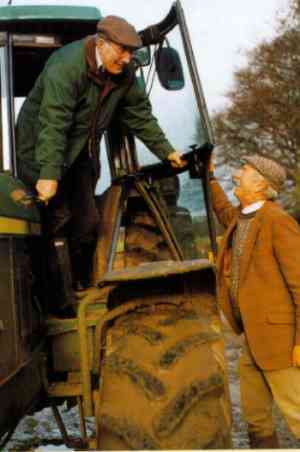
Above: John Neave and Joe Henson on the farm
COTSWOLD FARM PARK - Rare Breeds Conservation
By Elizabeth Henson - Photographs by Eileen Hayes
Adapted for the internet by Kirsty Tallon
COTSWOLD FARM PARK
"The Premier UK Rare Breed Survival Centre"
The Cotswold Farm Park is the 'home of rare breed conservation' set high up on the Cotswold Hills, England, in an Area of Outstanding Natural Beauty. Its comprehensive collection of rare breeds was first established in the late 1960's when many of our traditional breeds were faced with imminent extinction. Besides being a vital 'shop window' for the work of rare breeds conservation, it is an important breeding centre for many of the breeds we keep and combines a day out for the family in a safe and attractive environment.
CONTENTS:
THE RARE BREEDS SURVIVAL TRUST
THE ANIMALS:
|
Above: John Neave and Joe Henson on the farm | The Cotswold Farm Park is part of the 1600 acre Bemborough Farm which is a typical mixed family farm high on the Cotswold hills of England, 900 feet above sea level. It is farmed by my father, Joe Henson, and his partner and old school friend, John Neave. My brother, Adam, and I are also now part of the business. We are tenant farmers as the land is owned by Corpus Christi College, Oxford, while we own all the crops, livestock and machinery on the farm. The Farm Park, alongside the old Roman Road of Bucklestreet (which runs fron Broadway to Bourton-on-the-Water), is 25 acres of uneven pasture which when we were children we called the humpty dumps. A hundred years ago it was quarried for stone slates and the original tiles on the roofs of Corpus Christi College probably came from this field. In 1970, European Conservation Year, my father and John Neave decided to use this area, which was of little use to their commercial farm, to create a shop window for the work of rare breeds conservation. Here visitors to the Cotswolds could be told the story of British livestock breeding illustrated with our beautiful breeds so rarely seen in todays countryside. They could also be encouraged to support the work of preserving a vital part of our living heritage. Little did they realise how successful their idea would be or that the work they helped to start would spread to every corner of the world. |
Ever since humans first began to use and domesticate wild animals, they have been changing these animals, by selection, to suit their needs. At the beginning early farmers probably selected for friendly temperament and ease of handling, but later they developed strains of fast running cunning dogs to help them hunt, willing cattle and horses for draught work, milky, fine wooled sheep for cheese and cloth, prolific pigs able to scavenge on waste food and poultry which laid large quantities of eggs.
All of these things have come about by each livestock breeder only breeding from those animals which do the job best. Now if all farmers at all times and in all places were searching for the identical requirements then the ideal animals would probably have been created centuries ago and we would be content with one breed of each species. This is not the case. Not only do different communities have different requirements of their animals, which also have to suit their geographical and climatic conditions, but these requirements are constantly changing with changes in the affluence and well being of the population. For example, in the Middle Ages our rural population kept versatile animals which fulfilled several roles but did none of them particularly well. Today, our largely urban population demands high production for our agriculture which uses highly efficient, but single purpose livestock breeds. Our old self reliant, multi-purpose breeds have been reduced to pitfully low numbers and many have been lost.
There are three main reasons why we should preserve types or strains of domestic animals that are not needed by modern agriculture.
The first is as a living museum piece to enable people interested in our living heritage to come and see the type of animals our ancestors farmed. The second is for research, to study in detail the characteristics of these old fashioned breeds, but the most important reason is for the future. Our farming needs are constantly changing and if livestock breeders are to mould their animals to fit these changing needs it is vital that they have a pool of genetic material to fall back on. Once a breed is gone it's gone forever, and who is to say that in the future we will never need the characteristics of today's rare breeds.
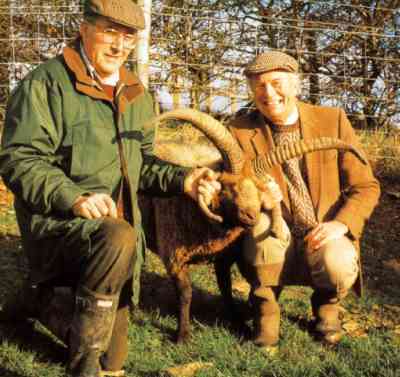
Above: John and Joe with a Manx Ram
In 1969 my father, Joe Henson, was invuited to join a working party of people interested in the conservation of rare breeds of farm animals. He soon added to his own small collection of local rare breeds, Cotswold sheep, Gloucester Old Spot Pigs, Gloucester Cattle and Shire Horses, and took over much of Lord Zuckerman's 'gene bank' of rare breeds from Whipsmnade Zoo in 1970. The collection was opened to the public in 1971 and has been a popular farm attraction ever sinmce with many visitors buying surplus breeding stock to establish their own flocks and herds thereby helping to ensure the continued survival of all our breeds.
THE RARE BREEDS SURVIVAL TRUST
In 1973 Joe Henson was founder chairman of a national charity established to ensure the continued survival of all our endangered rare breeds of British farm livestock. The Rare Breeds Survival Trust (R.B.S.T.) is now a thriving organisation with over 10000 members and has his Royal Highness the Prince of Wales as its Patron.
The R.B.S.T. carries out a regular census of all the less common breeds in the country and publishes a list of those in most immediate danger. These are ranked according to how much they are considered to be in danger due to low numbers, geographical isolation or small numbers of closely related breeding units.