SHEEP:
(Click
on any of the pictures to see a larger image)
We have flocks of 20 to 30
females of each of the breeds we keep at the Cotswold Farm Park
and we selet a small group of each breed for display. In the
early spring we exhibit yearling females while the breeding ewes
are lambing. We lamb in March and April, shear in June, wean the
lambs from their mothers in August and brgin the breeding cycle
again in October.
There are no less than 65
distinct breeds or types of sheep in Britain alone, each adapted
to a slightly different environment or selected for a different
specialised job. In general the breeds fall into five major
categories:
PRIMITIVE
SHEEP
These ancient and ancestral
breeds have remained unchanged for centuries by being isolated on
islands around Britain. Like all indigenous Northern European
breeds they are all small, light boned sheep with naturally short
tails and they all shed their naturally coloured wool in the
spring like any wild animal. Most, if not all the primitive
breeds, are rare even though many of them are very efficient at
surviving and producing in their own specialist island
environment.
SOAY
SHEEP
1973 - ENDANGERED (Isolated on one island, with
less than 500 ewes in other flocks on the mainland)
1994 - VULNERABLE (less than 900 ewes in mainland
flocks)
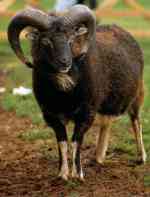 Soay Ram
|
Soays are the
ancestors of all modern sheep breeds and have remained
unchanged since the Stone Age by being isolated on the
islands of Soay and Hirta, off the West coast of
Scotland. Because they are light weight and do not need
intensive shepherding, they are ideal for grazing nature
reserves, where rare plants need to be nibbled to
maintain the botanical balance. The flock at the Cotswold Farm
Park is descended from a group brought from the island of
Hirta in the 1960's, and selected by professor Peter
Jewell from Cambridge University. Peter had spent many
years researching the behaviour and ecology of the island
flock and still takes an active interest in this group.
We interfere as little as possible with the natural
behaviour of the flock who still have a senior or 'king'
ram, groups of breeding females with a clear hierarchical
social structure and groups of young males who spend a
good deal of time play fighting in anticipation of one
day ruling the roost.
|
NORTH
RONALDSAY SHEEP
1973 - CRITICAL (2000 animals but all on one
island)
1994 - ENDANGERED (2 Island flocks and over 300
ewes on the mainland)
Descended from the Scottish crofters' sheep this breed has
been isolated on the most northerly Orkney Island of North
Ronaldsay for several hundered years. Here they live outside the
sea wall, where they have adapted to a diet of the seaweed,
'kelp'.
In 1973 my father, Joe Henson, flew up to the Orkney Islands
and bought the island of Linga Holm, which has big 'kelp' beds,
on behalf of the newly formed Rare Breeds Survival Trust. He
moved 150 sheep to Linga Holm as an insurance against the risk of
an outbreak of disease or an oil accident destroying the North
Ronaldsay flock. He also brought over 100 sheep south to found
several mainland flocks and greatly enhance our own group which
had been established in 1971. It was this project which led to
the successful launch of the Rare Breeds Survival Trust.
SHETLAND SHEEP
1975 - VULNERABLE (less than 900 ewes)
1994 - MINOR BREED STATUS (less than 3000 ewes)
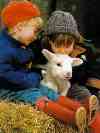 Above: Kate and James meeting a Shetland
Lamb
|
Also descended from Scottish crofters' sheep, the
Shetland has been selected over many yeatrs for wool
quality, and today produces the finest wool of any of our
native breeds. It is said that a four foot square shawl
made fron Shetland wool is so fine it can be pulled
through a wedding ring. Although Shetlands became rare
in the 1970's they have become a popular breed for small
flock owners who are interested in spinning, and
producing lambs for the freezer. On the Shetland Islands
most of the sheep are white but the Shetland is found in
a beautiful range of colours from black through greys,
browns and tans to white. Our flock was established in
1973 with sheep from the Shetland Islands and we have
always specialised in maintaining and exhibiting
induviduals with a wide variety of natural colours.
|
HEBRIDEAN SHEEP
1975 - CRITICAL (less than 300 ewes)
1993 - VULNERABLE (less than 900 ewes)
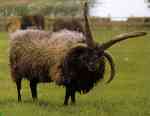 Four
horned Hebridean ram
|
These impressive black sheep grow two,
four and sometimes even six horns. The legends say that
they were brought to this country by the Viking invaders
and it is certainly true that there are multi-horned
breeds, or the archaeological evidence of them, in many
of the places the Vikings settled. These include the Manx
Loughtan from the Isle of Man, and multi-horned sheep on
Shetland, Iceland, and even North West Africa and their
remains in the Canary Islands. The
Hebridean is no longer found on the Hebridean Islands of
Scotland but has survived to this day as an ornamental
parkland breed. Our own flock was established from the
Whipsnade Zoo gene bank flock in 1969 and has been the
foundation for the many small hobby flocks throughout the
country. Like many of our once critically rare breeds the
Hebridean is now greatly benefiting from the active
support of an association of breeders promoting its'
attributes.
|
MANX LOUGHTAN
1975 - CRITICAL (less than 300 ewes)
1993 - VULNERABLE (less than 900 ewes)
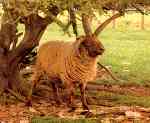 Four horned Manx Loughtan ram
|
Like its cousins the Hebrideans, Manx
Loughtans will grow two, four and sometimes even six
horns. The word Loughtan was derived from two Manx words,
'Lugh' meaning mouse, and 'Dhoan' meaning brown. They are
a beautiful rich brown when they are born, and when they
are shorn, but the sun bleaches the tips of the wool, so
that they appear tan in colour for much of the year. Our flock was established in 1971 with sheep
from the Whipsnade 'gene bank' and a ram collected by our
director John Neave in a light plane he flew over to the
Isle of Man himself. We have produces some outstanding
sheep over the years and taken championships at the Rare
Breeds Survival Trust National Show and Sale in 1977,
1978, 1986 and 1987.
|
JACOB SHEEP
1973 - MINOR BREED (over 3000 ewes)
1993 - No longer classified as a Rare
Breed
| The Jacob is a spotted, multi-horned
breed, but it is not really a primitive breed, because it
has a long tail and does not shed its wool naturally in
the spring. However, it is a cousin of the Manx and the
Hebridean and the breed most peoplr think of when you
mention rare breeds although it is in fact no longer
classified as rare thanks to the enthusiastic support of
hundreds of small flock owners throughout the country. Joseph's coat of many colours is thought to have
been made from the wool of Jacob sheep and The Bible
certainly records advice given by God to Joseph's father
Jacob, on how to breed spotted lambs. The advice included
putting spotted sticks around the water holes and using
only spotted rams. (Genesis 30 and 31) This is probably
the first written record of selective breeding !
We began breeding Jacobs in 1969 and
like so many of our breeds were too attached to them to
give them up, even when it was clear they were no longer
critically rare.
|
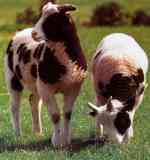 Jacob
lambs
|
CASTLEMILK MOORIT
SHEEP
1973 - CRITICALLY RARE (less than 20 ewes)
1993 - CRITICALLY RARE (less than 300 ewes)
| The Castlemilk Moorit breed was
developed in the Castlemilk Estate Park in Dumfriesshire
by the Buchanan Jardine family, during the early years of
this century. The breed was created from a number of
breeds which are now all rare, and it was intended to be
an easy care breed that would produce top quality moorit
coloured wool for the family's own use. In 1973 the flock
was dispersed with only 10 survivors. Six sheep were
evacuated to the Cotswold Farm Park and four others were
bought by a neuighbour. By the use of a very careful
breeding programme the nimbers have gradually increased,
and it is hoped that we have managed to save them from
extinction. |
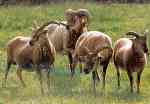 Castlemilk
Moorit sheep
|
MOUNTAIN BREEDS
HERDWICK
SHEEP
A very large part of Britain is mountainous
land which produces little more than rough grazing for sheep. The
harsh weather and sparse grazing has helped to create breeds able
to survive in these conditions. They are intelligent sheep whose
hardiness, thrift and mothering ability have been the basis of
our sheep industry for centuries. Traditionally mountain flock
masters have pure bred self replacing flocks. The lambs learn the
terrain and how best to use it from their mothers so that when
farms change hands the flock which is acclimatised to that farm
or 'Hefted' is sold with it. Those ewes not needed to breed flock
replacements are mated with prolific longwool breeds to produce
half-bred ewes. These ewes retain some of the hardiness and
mothering ability of their mountain dams, together with the
ability to milk well and have twins from their father's breed.
They are the speckled faced, loose wooled sheep you wil have
probably driven past on your way to the Cotswold Farm Park.
Each of the moubtain regions of Britain has
developed its own breed, such as the Scots Blackface, Swaledale,
Cheviot and Welsh Mountain. The latter breed has a number of rare
colour variations, the Black Welsh Mountain, the black bellied
Badger Faced Torddu, white bellied black Torwen and the Balwen
with a black body and white blaze and feet.
HERDWICK SHEEP
Not classified as a rare breed but
locally adapted and isolated
| The hardiest British breed, adapted to
live in the wettest part of the country is the lovely
'blue' Herdwick sheep from the Lake District. Born dark
they tend to get lighter each year of their lives. They
have a very coarse wool which makes into hard wearing
carpets and they are a goodexample of the genetic
extremes found within domestic sheep. They are not
classified as a reare breed because they are still quite
common in the high mountains around the lakes of Cumbria.
They are, however, restricted to a very small
geographical ranmge, which makes them potentially
vulnerabler to disease, or changes of fashion. Our flock
was established in 1973 and we go back to the Lake
District every two years to buy a new ram or 'tup' as
they are called. |
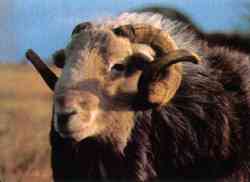 Herdwick ram (NB: No larger image available.
Sorry!)
|
LONG WOOLED SHEEP
Large long wooled sheep were originally brought
to Britain by the Romans and were then regionally specialised
into a number of breeds. The rams are traditionally used to cross
with mountain ewes to produce prolific half bred females for
prime lamb production. These half bred ewes in turn are crossed
with rams of the Down or meat breeds to produce best prime
English lamb. The commercial sheep industry is therefore based on
cross or half bred sheep, but in order to create these it is
essential that the pure strains with all their special
characteristics are maintained as separate breeds.
COTSWOLD SHEEP
1973 - CRITICALLY RARE (less than 500 ewes)
1993 - VULNERABLE (less than 900 ewes)
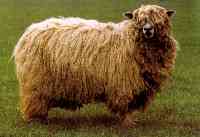 Champion
Cotswold ewe
|
These sheep, decended from Roman
stock, once roamed the Cotswold hills in their thousands,
and were known as the 'Cotswold Lions'. In fact the hills
take their name from the sheep. These were the 'wolds' or
bare hills of the sheep 'cots' or sheep enclosures.
During the Middle Ages their wool was sold to produce
great wealth, enabling local merchants to build beautiful
Manor Houses and Churches. A
Cotswold sheep produces a fleece weighing an average of
5.5kg (12 lbs) of long lustrous wool each year and this
wool is still made into traditional rugs or 'throws',
dyed in the colours of our local Cotswold stone, lichens
and mosses. By 1969 there were only a handful of flocks
remaining. My father Joe Henson encouraged me to but a
small group when I was only 11 years old, having been
forced to sell my pony after a riding accident. I soon
became enthusiastic about the breed, especially after
winning several prizes at our local agricultural show.
|
I was secretary of the breed Society for a
number of years and was honoured to be it's Chairman for the
Societies centenary year in 1992. With the help of that Society
the breed has been gradually increasing in numbers and has
created a local demand for Cotswold woollen products and quality
Cotswold meat which may be purchased in some local buchers and
hotels.
WENSLEYDALE SHEEP
1973 - ENDANGERED (less than 500 ewes)
1993 - VULNERABLE (less than 900 ewes)
| Wensleydale cheese was once made from
the milk of Wensleydale sheep and they grow beautiful
wool which hangs in long shiny ringlets and is often
called 'poor man's mohair'. They were develpoed in
Wensleydale in Yorkshire where they were used to cross
with the hardy mountain ewes. Their half bred daughters
were more prolific than their mothers, had more milk to
feed their own lambs, and better fleeces. Wemsleydale
crosses have no brittle kemp fibres in their fleece, a
problem which is common in the mountain breeds. A black
register was recently established for Wensleydales and
our first black lamb was born here in 1992. Our lamb
flock is now registered in the name of my son Ewan, who
was born the same week, thereby continuing a family
tradition of "starting 'em young !" |
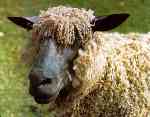 Wensleydale
ewe
|
HILL
BREEDS
The 'hill' sheep are pure
breeds which fulfil the same prolific role as the mountain cross
longwool half bred ewes.
KERRY HILL SHEEP
1973 - locally common
breed (more than 10000 ewes)
1993 - Watching Brief
(less than 3000 registered ewes)
| This breed was develpoed in the
Welsh Border counties and is only now becoming rare. They
are excellent mothers, often produce twins and have
enough milk to ensure those lambs grow well. Sadly they
are reducing in numbers due to changes in local fashions
and markets, which currently favour faster growing leaner
lamb for the supermarket. They
are strikingly attractive sheep with a white fleece. The
face and legs are also white with black ears, nose, eye
patches, knees and feet. Thirty years ago my father had a
large commercial flock of Kerry Hill sheep, on the farm
he managed before moving here. They are the newest
addition to the breeds at the Cotswold Farm Park,
introduced in 1989.
|
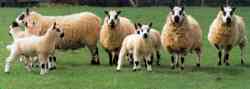 Kerry Hill sheep
|
DOWN
BREEDS - Southdown, Oxford Down and Suffolk
The Down breeds are the
specialist meat breeds of the sheep industry developed to produce
quality lambs. They have tightly crimped wool and a rather teddy
bear appearance. Because they have been protected from harsh
environmental conditions by careful management, and develpoed for
carcase and wool quality, they now need high lebvels of feed, and
careful management throughout the year, but particularly at
lambing time when they are housed and cared for 24 hours a day.
NORFOLK
HORN SHEEP
1971 - VERY CRITICAL (only 4 rams and five ewes)
1993 - CRITICAL (less than 300 ewes)
| This is the traditional breed of the Brecklands of
Norfolk where they were used to create the Suffolk, our
most famous and popular British meat sire. The Norfolk
Horn was an extensive ranging breed which did not take
well to the modern enclosure and penning of sheep. Their
numbers declined until by 1968 only 4 rams and 5
infertile ewes remained. The Cotswold Farm Park's
Bemborough flock of Norfolk Horns was established in 1969
and was part of an emergency breeding programme organised
with Reading University and The Royal Agricultural
Society of England. The idea was to breed the last
remaining rams with Suffolk ewes and 'grade up' to try to
save what was left of the breed. By this time the last
remaining rams died we had a small population of sheep
which were over 80% pure bred Norfolk. A closed breeding
programme was developed and maintained for nearly 20
years. Our own flock is divided into four bloodlines each
descended from one of the last remaining pure bred rams.
The project has been very, very successful although the
breed is still very rare and great care must be taken to
avoid the breeding of close relatives. Despite all these
problems in 1993 we were able to hold the largest sale of
Norfolk Horn sheep this century at the Cotswold Farm Park
selling 42 surplus animals bred here to establish new
flocks.
|
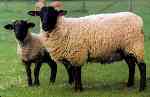 Norfolk Horn ewe and lamb
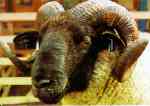
Norfolk Horn ram
|
PORTLAND SHEEP
1973 - CRITICAL (less than 300 ewes)
1993 - ENDANGERED (less than 300 ewes)
The legends say that the ancestors of the
modern day Portland swam ashore from the sunken ship of the
Spanish Armarda. Sailors often carry livestock for fresh meat,
but usually pigs and chickens, rather than sheep, and probably
not into battle.
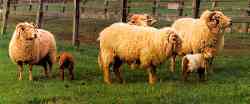 Portland sheep
|
It is most likely that the Portland is
all that is left of the Western Tanfaced horn, common in
the South west during the Middle Ages. It has indoubtedly
got Spanish blood, and was the first breed of sheep in
Britain able to have lambs at any time of the year, but
it is more likely that this characteristic was introduced
through trade. Our native breeds are only fertile in the
autumn, and have their lambs in the spring. The Cotswold
Farm Park flock was established in 1970 when the gene
bank of rare breeds was moved from Whipsnade Zoo to make
room for their breeding herd of White Rhino. |
Back
to Top of Page
To
Equines / To Pigs
/ To
Goats / To Cattle / To Poultry
and Waterfowl / To Other
Animals
Back
to Cotswold Farm Park